Frugal Tuesday: Make Your Own!

A few years ago, in one of those hip-but-quaint coffeehouses, there were bags of cello-wrapped handmade marshmallows hanging out by the cash register. $7 for a bag of four didn’t seem like too much to pay for something that would delight Mr Vega so much. And they were fantastic… Fluffy, light, nothing like the half-eaten bag of stale jet-puffs that always seemed to be in the cupboard but no one remembered buying it… Or eating any

Imagine my delight when I came across Alton Brown’s homemade marshmallow recipe. The same $7 I spent on four perfect marshmallows will make me over a hundred of the very same ones at home, and they are just as delicious as the expensive ones.

And even though it’s dead simple, people think you’re kind of a badass when you make the stuff they’re used to buying.

Think about the ways in which you indulge yourself and question whether you might try making it yourself. Around here, in addition to marshmallows, we make our own kahlua, cherry liqueur, cold brew coffee, hot cocoa mix, peppermint bark candy, hot buttered rum batter, and just recently, I’ve graduated to basic body-care products, including a grapefruit salt-scrub and a whipped body butter. All for a fraction of the cost of store-bought, and we think the quality is better when we make it ourselves.

Why not give it a shot? The worst that could happen is that you don’t like it, or you find its not fun. But you’ll never know until you try!

Frugal Tuesday: Check Your City’s Webpage

Many cities and utility companies have money-saving programs that residents are unaware of. In Los Angeles, we were able to find free mulch and compost, free large-item pickup tags, discounted worm composting bins (in exchange for attending a 2-hour class). Here in Austin, discounts on composters are also offered, as well as free paint, mixed from people’s hazardous-waste drop-offs! We have taken advantage of numerous opportunities for rebates offered through our local electric company, and just this past weekend, we got a couple of free shade trees for our Little Hippie House through an energy-company partnering with TreeFolks.

CWCrB_7UwAAsezM


Take a few minutes to browse around and see what your city or utility company might be offering that you can use… you may be surprised by what you find!

Frugal Tuesday: Grow Your Own

IMG_0062

I always thought I had a “black thumb,” but it turns out that gardening just takes practice! I’m not even close to being a Master Gardener, in fact I’m still very much a novice, but the more you do it, the better you get.

If you are new to gardening, know this: You will kill plants, and many of them! It’s okay. The planter pictured above cam with strawberry plants in it. We didn’t do a great job with the berries, and have re-purposed the pot as an herb garden. Each plant you kill adds to your list of Things Not to Do, and it will start to happen less and less.

Find out your gardening zone, look up the best times to plant in your region (hint: there are several ideal times each year, not just one), experiment with seedlings and try growing things from seed. If all you have is a balcony or patio, get some containers. If all you have is a sunny window, try growing some herbs. If you don’t have that,  consider joining a community garden, or try what my friend does and Stealth Garden! Seriously, she’s got a culinary herb garden hiding in plain sight among her apartment building’s landscaped shrubbery… some of her more astute neighbors even help themselves– with her blessing– to a trimming now and then! There may be an overlooked bit of soil on the property where you live or work where you might be able to plant a small Stealth Garden (or Stealth Plant) of your own.

Grow what you like to eat (or to make herbal tea out of, or to smoke, providing that it’s legal to grow where you live). To get the most bang for your buck, figure out which fresh fruits and vegetables you pay the most for, then try growing them yourself. It’s so much nicer to walk outside with a pair of scissors to get fresh herbs than to pay $3 for a plastic-wrapped sprig of already wilting thyme, oregano, or rosemary.

Give it a try. In a world of over-processed, over-packaged, nutrient-deficient food products, gardening is a revolutionary act. And a delicious one at that. Why not try it?

Skinny-Fat Finances

We’ve all met those people who are model-thin without effort. They eat whatever they want, they rarely exercise, they drink and smoke, they seem to live on a diet consisting mostly of fancy whippy coffee beverages, and still everything they wear looks good on them. Some of them even struggle to keep weight on when life gets stressful. But a deeper look into their medical charts might reveal hidden health problems such as heart disease, liver dysfunction, or diabetes. While many people work hard to maintain their healthy weight and fitness levels,  there is a portion of the population who look healthier than they are: the “skinny-fat.

Financial health is no different than physical health, in that what can be seen from the outside doesn’t always represent what’s happening behind closed doors. And in exactly the same way that Western society places a higher value on being thin than it does on being healthy, we are all also encouraged to look rich, rather than to be financially stable.


Both Mr. Vega and I were raised in skinny-fat financial households. Our Baby Boomer parents were the first generation of Americans with access to the easy credit we have all become so accustomed to. “Low monthly payments” must have felt like a godsend to our young parents, who wanted so much for their children to have the best of everything. They would have had no way of predicting that their resulting financial stress would affect us much more deeply than going without some luxuries might have.

We don’t remember what we got for Christmas or our birthdays every year, but we remember clearly the bills that came in pink envelopes. We remember the way our parents tried to ignore the telephone’s incessant dinnertime ringing, and the occasional times we had to bathe in cold water or to get ready for school in the dark because the utilities had been shut off for lack of payment. I, for one, will never forget coming home from school one day  in my teens to an IRS lien notice stuck to my front door, and spending the afternoon at a friend’s house, because I felt certain I would go to jail if I went into my house (everything got sorted out, and we got to keep our house, but that was a terrifying day for me).

As we approach the gift-giving holidays, we are bombarded with TV commercials showing children’s faces lighting up as they open their”perfect” presents on Christmas morning. Images abound of delighted spouses peeking into tiny jewelry boxes, or leaping around brand-new beribboned vehicles in the driveways of their lovely suburban homes. Who wouldn’t want to inspire that sort of joy in the people we love?

What those commercials don’t show is those same parents fighting over money in January (and February, and March…) when the bills arrive. We aren’t seeing those same children being told to “Tell them I’m not here” when the debt collection agencies start calling. The visions of happy families road-tripping to visit Grandma never reveal the expired insurance policies hidden in the glove box.

Here’s the thing: if you can afford a house with a yard for your kids, and a nice Compact Utility Vehicle to drive them around in, good for you. If designer clothes, annual vacations, and weekly mani-pedis are within your means, then party on. Nice things are… well, nice! We want to have them, and we want you to have them.

BUT (there’s always a “but):

If you are buying holiday gifts on a credit card that you will not be able to pay in full when the bill comes, you might be suffering from skinny-fat finances.

If you are considering a large purchase and your main concern is the amount of the monthly payment, rather than the total cost of the item, you might be suffering from skinny-fat finances.

If you bought and strung a million twinkly lights outside your house last weekend, but couldn’t make your rent or mortgage payment Tuesday, you might be suffering from skinny-fat finances.

We are here to tell you from personal experience that a little less stuff, a little less sparkle, a little less bling isn’t going to hurt anyone, but that getting it when you really can’t afford it could actually cause lasting harm. Living in a smaller home, driving an old-but-paid-for car, opening fewer gifts on holidays… none of that is so bad if you get to eat your holiday meal with loved ones who aren’t fighting, if your heart doesn’t pound every time the phone rings, if you aren’t afraid of the mailbox.

Anyone who has been there can tell you that being healthy is so much better than simply being skinny. And financial stability– freedom from debt, carrying enough insurance, and having enough money on hand to weather emergencies– feels so much better than looking wealthy, but worrying constantly about when it’s all going to fall apart.

If your finances are skinny-fat, just like with your body, you can’t heal them overnight. But you can begin to shift how you navigate life. You can refuse to put even one more non-essential purchase on a credit card. You can begin to record your expenses and get a clearer idea of where your money is going. You can begin to cultivate contentment and seek happiness in experiences instead of things.

And if you keep at it, before you know it, you will find that you have everything you need, and maybe more of the things you want. Before you know it, you’ll be looking back and thinking about how much better you feel than when you were over-extended and stressed about money all the time. Who knows? You may even be able to afford that shiny new thing you’ve always wanted… with cash!


IMG_1388


Frugal Tuesday: Batch Cooking

Taking an afternoon to whip up a batch of burritos, or really anything that freezes well, isn’t always my first choice for weekend fun. But every time I do it, I’m glad I did. Having some grab-and-go breakfasts, and also some lunch or dinner meals ready and waiting, keeps us eating more healthfully and also saves us from the siren song of takeout or delivery.

This weekend, we made breakfast burritos, and my comfort-food favorite, bean & cheese. What are some of your favorite make-ahead meals?

Frugal Tuesday: Create Less Trash

IMG_0084

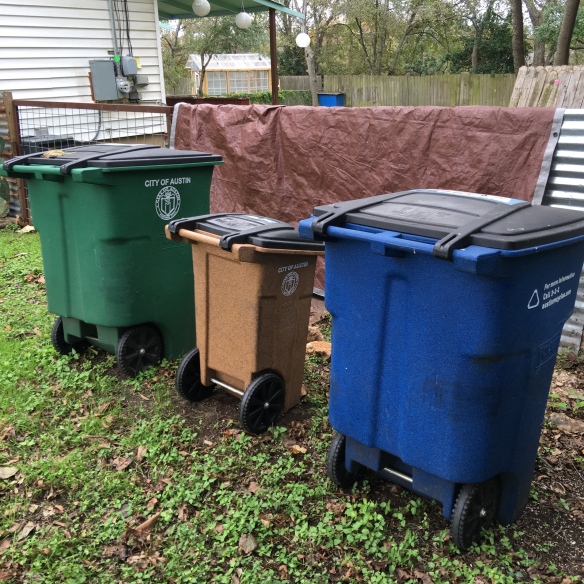
Our new, smaller trash can was delivered today. After the initial mess of moving in calmed down, we noticed that we weren’t filling up the city-provided can that was here when we bought the house.  If we forgot to take it out to the curb for a week– or even two– it was no big deal. We’re fortunate to live in a city that provide curbside recycling and even composting, and we also make an effort to buy used, and buy items with less (or at least recyclable) packaging. While we’re far from perfect, we think our new 24-gallon can will accommodate our landfill trash needs perfectly. The best part? Making the switch to a smaller can will save us about $8/month on our trash pickup bill, as compared with the 64-gallon can we had before. I can think of a lot of things I’d rather do with $96 a year than spend it on garbage. Plus, all the coolest neighbors on our block have the smallest can… peer pressure works, y’all!

If you are living in an apartment, or somewhere you don’t pay for trash pickup, focusing on generating less landfill trash might not seem like a money-saving activity, but it still is. You might be able to save your bottles and cans to recycle for return for cash. You might try starting a worm composting bin on your patio or balcony, which is an easy way to turn your daily food scraps into nutrient-rich compost that your potted plants will love. Your efforts at reducing your trash production may find you buying from the bulk bins and farmers markets, buying used, or going for out-of-the-box floor models at deep discounts. You probably already shop at stores that gives you a nickel or a dime off your grocery bill when you bring your own bags. The more lightly we can live on the planet, the more money we can keep in our pockets!


Frugal Tuesday: Use it Up!

Yesterday I made a honey-lime vinaigrette salad dressing directly in the nearly-empty honey jar. 1/4 cup apple cider vinegar, 1/3 cup olive oil, and the juice of two limes… the recipe called for two teaspoons of honey, which was about how much was left in the container.

It went beautifully with our grilled chicken and pineapple salads!

How do you get the last bits of product out of their containers?

Nothing Changed When we Paid off our Debt

Mr. Vega and I became debt-free a couple of years ago. It happened quietly, and without fanfare. He’d been working hard to negotiate some old, unpaid credit card bills that had gone to collection, and ended up settling about $10,000 worth of debt for around $4,000, one bill, one phone call, at a time. The only thing left was my car payment, which for some reason, I had been stalling on paying off even as we amassed a healthy savings account. Then one day, on a break from work, I called the loan company and did the payoff over the phone. Just like that, we were free from debt.

And nothing changed.

Not having monthly payments outside of rent and utilities is nice, but we have continued to save so aggressively that our lifestyle hasn’t changed: we cook at home, search out free and inexpensive entertainment, consider even the smallest purchases carefully, and do our best to negotiate the best rate for everything we spend money on. This year, I volunteered to be a support person for our bocce league in exchange for free registration ($45), and a $25 weekly credit, which I share with Mr. Vega, at the team’s sponsoring pub. We exchanged both our juicer and our vacuum cleaner several times because we kept finding lower prices. And on our last Date Night, we hustled over to a local bar right after work because the first sixteen customers that ordered cheese plates (normally $16) got them for free. We chase bargains because it’s fun for us: we like getting a good deal nearly as much as we enjoy whatever it is we’re buying or consuming. Living frugally helps us live a little more lightly on our ailing planet, as well: growing and cooking as much food as we can for ourselves eliminates a lot of packaging, as does buying in bulk. Every article of clothing that we buy used or trade with friends is one less thing that has to be shipped from overseas and then driven by truck to our local store. Our habits and practices are right in line with those of our friends who earn less than we do, or who are busy paying off debt themselves. We also socialize with people whom we suspect make and have much more money than we do, but our friendships revolve around time spent together enjoying activities that don’t cost much, so the subject of money rarely comes up.

This week, I made a long-overdue phone call to roll a 401(k) from a previous employer into a personal IRA. I spent quite a bit of time speaking to a customer service agent at the investment firm, who was gathering our personal financial information in order to ensure I was getting into a product that met our needs (and presumably the company’s need for profit, as well). Part of our conversation went like this:

CUSTOMER SERVICE GUY: Okay now, so, if we were to take all your debts, your car loans, personal loans, credit cards, home equity lines of credit, and student loans… how much money would it take to pay all of that off today, hypothetically speaking?

ME: Three hundred and forty dollars. We use an airline miles credit card that we pay off each month.
(pause.)
CUSTOMER SERVICE GUY: WOW. Well, um… Congratulations!

I really enjoyed the feeling of hearing someone who is privy to the innermost financial workings of thousands of families so taken aback. We are not wealthy, earn a modest income, and in fact, are woefully “behind” in our retirement savings, but simply being debt-free is so unusual, it seems, that it rendered this guy momentarily speechless.

So, nothing about how we live our daily lives changed when we paid off our debt. We didn’t buy fancy new wardrobes, take a vacation, or start upgrading our electronics. But there is an indescribable lightness about us now that we go to work every day because we want to be of service and earn money to save for our house instead of showing up just because we couldn’t make the rent if we didn’t. Car troubles for us these days are inconveniences and not crises. And we moved halfway across the country to pursue our dreams knowing that if an emergency should arise for any of our family members, we could afford to be at their side within a day’s time.

Nothing really changed when we paid off our debt… but somehow, everything is different.