My grandfather gave me my first car, which had been his, when his deteriorating vision made it unsafe for him to drive any longer. It was a seven-year-old Oldsmobile that had begun its life as a rental car. It lasted four more years in the negligent possession of my teenage self, before literally going out in a blaze of glory (due to a previously undetected fuel line leak) on a California highway.
I bought my first– and only— brand-new car when I was 22, because I didn’t have the credit to finance a used car (there’s some great logic). The cheapest thing on the lot was a 3-cylinder Geo Metro convertible, which I drove for six years, until it was totalled in an accident that left me unharmed, but also left me with an insurance check that wasn’t nearly enough to replace the car. I worked out a deal with a friend’s brother who was joining the military, and no longer had use for a car. He gave me a great deal on his 10-year-old Honda, and let me pay him in two installments.
When that car was about to die, at the end of my twenties, my terrible credit and I managed to get a decent deal on a five-year-old Miata, but I had to list TEN references to qualify for a loan. I finally began to learn the value of regular car maintenance and started keeping to a budget that allowed my poor credit to recover. When that loan was paid off, I drove debt-free for three more years, but I didn’t set anything aside for the day when I would need another car.
My final auto loan was as well-researched as the car purchase, and I was so proud to walk into the dealership with a check from the finance company, gotten at a great interest rate. I paid the car off early, and went all Scarlett O’Hara: “With God as my witness, I’ll never make car payments again!”
Mr. Vega and I began dating as he was just coming out of a prolonged period of unemployment, and he was driving a 1987 Wag-o-Van that he had gotten through a friend-of-a-friend for $400, and that wasn’t very safe (or even street legal). I only rode in it once, and it was so frightening, I still have flashbacks! He was hired as an outside sales representative, and found himself in the heartbreaking position of having to use his first month’s pay to buy a reliable car for work instead of traveling to attend the wedding of his only brother at a resort in Mexico. He paid all the money he had in the world–$3500– for a well-maintained twenty-year-old Honda CR-X with 200,000 miles on it, and spent the rest of the summer helping me come up with creative recipes from my Project Angel Food box (remember those?), and the fresh produce I got from my friend’s backyard garden. His co-workers ribbed him for driving such an old car, but the jokes quieted down when one of their luxury cars was repossessed from the office parking lot one day, in full view of everyone.
We commuted to our jobs in our paid-for cars as we saved up to pay cash for our own modest wedding. We parked them out in front of the cheap 486-square foot apartment we rented in an edgy neighborhood, while we paid off the last of our debt and began to aggressively fund our Emergency Fund. We looked for Groupons for oil changes, and Mr. Vega did most minor repairs and maintenance himself. We drove those cars to the library to borrow DVDs for our weekend entertainment, and occasionally for a splurge at the $3 movie theater.
By the time my car began to develop problems that a series of mechanics could not resolve, our new frugal lifestyle had left us with enough cash in our Emergency Fund to replace it, or even upgrade (in Los Angeles, car trouble definitely qualifies as an “emergency”). We test-drove a bigger, nicer truck. We tried out a newer model year of the same SUV I’d been driving. Ultimately, we chose a late-model subcompact that used about $40 less in gas each month than my SUV had. Even with the mystery mechanical difficulties, we were offered enough in trade to offset about half the cost of our new-to-us car. We wrote a check for the rest, and our ultra-thrifty habits helped us replenish the Emergency Fund over the next several months, and even begin saving to buy a house someday.
After three more years of a daily 40-mile round-trip commute, the CR-X was beginning to need more frequent, and more costly repairs, but still had enough life in it to bring it to Texas from California when we moved here earlier this year. We also wanted to make our next car purchase in Texas, where we knew we’d save about $1000 on registration and taxes alone, all else being equal. In addition to saving for a house, we started a little Car Fund and began making small weekly deposits.
Finally, the day came when Mr. Vega had had enough of playing the “Will My Car Start Today?” game, so we sat down to look at our budget and consider our options. We found that over the previous twelve months, we had spent a bit more in repairs than the vehicle was actually worth. He advertised his little Honda (with full disclosures) on Craigslist, for the same $3500 he paid for it, and the offers started pouring in. No one expects a car that old to be trouble-free, and that model is still widely sought-after. The young man who bought it was thrilled to get a “classic” car so cheaply, and will happily spend his weekends working on it in the driveway. The money we got from the sale of that car and what we’ve set aside in our Car Fund paid for about 1/2 of the newer car, and the rest came from our House Fund (we both agreed that this time, our car purchase did not qualify as an “emergency,” and have decided that we are willing to delay a home purchase for a few months in order to purchase the car).
My husband had been wanting a pickup truck for quite some time, and now that we live in Texas, it seemed an obvious choice. He test-drove half a dozen of them, but found the ones in our price range to be about ten years old, and with more than 100,000 miles on them. As reliability was the most important factor to us, we set our sights on something smaller. Since we were replacing a two-seater, we reasoned, we might as well consider another. We narrowed our search to Smart Cars and Miatas, and eventually, the Miata won. We came across a 1997 model with only 27,000 miles on it, but that one was snapped up before we could even drive it (someone got a great deal!). Finally, we found a 2009 MX-5 that was in mint condition. Mr. Vega staged a battle on the showroom floor when they nearly sold it out from under us after he had negotiated a price and announced his intention to buy it, but he emerged victorious, wrote a check, and left his own car in the dealership parking lot to come get me from work in our new roadster. As all happily married men know, “Mama Gets the Good Car,” so I’ll be cruising with the top down while my husband takes the subcompact to work.
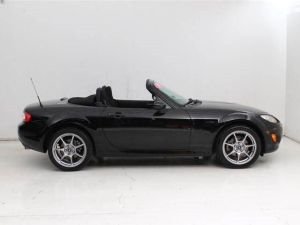
Meet our new-to-us car, which I have named “Benedict Cumberbatch”
Later that night, he examined the paperwork he found in the glove box: The original owner financed the car when it was brand-new, paid on it for five years, had it serviced like clockwork at the dealership, and the moment the loan was paid off, he got 1/3 of what he paid for it (not counting interest) to use as a down payment on another new car.
What WE got was a five-year-old, meticulously cared-for car with lots of upgrades, for below blue book value. Unless our needs change, and if nothing terrible happens to the car, we’re likely to keep it for a decade or more.
It will take us a few months of hard work and careful spending to get our House Fund back to where it was before this purchase, but we’re fortunate that living far below our means has become a way of life for us. We eat a lot of home-cooked meals, seek out free entertainment, and we only buy clothes and shoes when what’s in our closet begins to wear out. Those things are mostly fun for us, though, and even when they aren’t we do them happily, because when bigger things (like cars and computers) need repair or replacing, we’re able to handle it without going into debt. And most importantly of all, we’re flying back to Los Angeles in a couple of months to meet our brother and sister-in-law’s first daughter… We’re hoping our new way of living means we never have to choose between showing up for family and being self-supporting again!
Have you ever paid cash for a car? Would you even want to? Why or why not?
 Little Hippie House